
 By Rightful Advice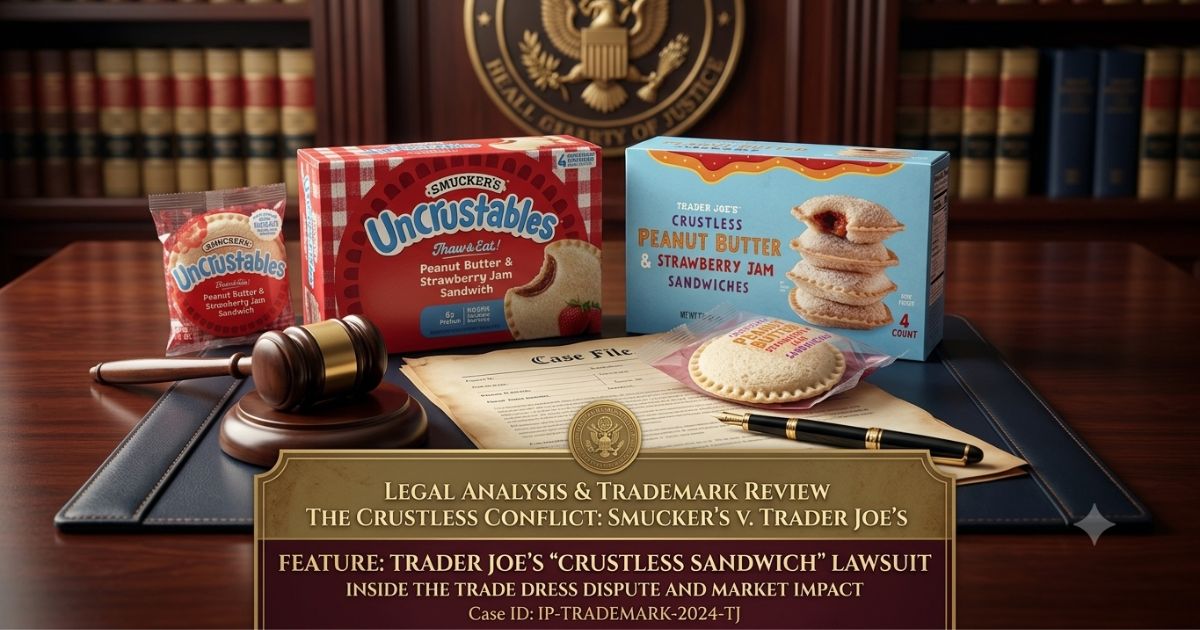
The J.M. Smucker Company filed a federal trademark and trade dress lawsuit against Trader Joe’s Company in October 2025, alleging that the grocery chain’s frozen crustless peanut butter and jelly sandwiches and their packaging too closely resemble Smucker’s popular Uncrustables brand. The case, captioned The J.M. Smucker Company v. Trader Joe’s Company, No. 5:25-cv-02181, is pending in the U.S. District Court for the Northern District of Ohio before Judge John R. Adams.
This dispute centers on longstanding principles of U.S. trademark law under the Lanham Act, particularly the protection of product configuration and packaging trade dress. It raises questions about the boundaries between legitimate private-label competition and actionable infringement when a store brand product and its packaging evoke a well-known national brand.
Background on the Products and the Dispute
Uncrustables are frozen, crustless, sealed peanut butter and jelly (or other filling) sandwiches that consumers thaw before eating. Smucker has sold versions of the product for decades and describes it as the leading brand in its frozen handheld category. According to the complaint, the company produces roughly 1.5 billion Uncrustables annually and has invested more than $1 billion over approximately 20 years in developing the brand, its goodwill, and related intellectual property. Sales of Uncrustables reached approximately $920 million in fiscal year 2025, reflecting sustained double-digit growth.
Smucker asserts trademark rights in several elements it collectively refers to as the Uncrustables Design Marks. These include the three-dimensional product configuration of a round, pie-like sandwich with distinct peripheral undulated (crimped or wavy) edges, pictorial representations of a whole round crustless sandwich, images of a sandwich with a bite taken out showing the filling, a stylized blue-and-white word mark, and related design elements. Some of these marks are federally registered.
Trader Joe’s introduced its own “Crustless Peanut Butter & Strawberry Jam Sandwiches,” a frozen product sold under the retailer’s private label. Smucker contends that Trader Joe’s product features a similar round or rounded shape with crimped edges and that the packaging uses a comparable blue color for lettering along with an image of a sandwich with a bite taken out. The complaint characterizes the offering as an “obvious copycat” intended to trade on the recognition and goodwill of Uncrustables.
Smucker has stated that it does not object to other companies selling prepackaged, frozen, thaw-and-eat crustless sandwiches in general. Its objection is limited to the alleged use of its protected design and packaging elements.
Legal Claims Asserted
The complaint alleges several causes of action:
- Trademark infringement and trade dress infringement under the Lanham Act (15 U.S.C. § 1114 and § 1125(a)).
- Trademark dilution.
- Unfair competition and false designation of origin.
- Violation of the Ohio Deceptive Trade Practices Act.
Trade dress protects the overall visual appearance of a product or its packaging when that appearance serves as a source identifier and is non-functional. Classic examples include the shape of a Coca-Cola bottle. To prevail on a product-configuration trade dress claim, a plaintiff generally must show that the design is distinctive (either inherently or through acquired secondary meaning) and non-functional, and that the defendant’s use is likely to cause consumer confusion as to source, sponsorship, or affiliation.
Functionality is a critical defense. A design feature is functional (and therefore not protectable as trade dress) if it is essential to the use or purpose of the article or affects its cost or quality. Courts examine whether the feature is dictated by competitive necessity or whether alternative designs are available.
Dilution claims under federal law require proof that the mark is “famous” (widely recognized by the general consuming public) and that the defendant’s use is likely to dilute the distinctive quality of the famous mark, either by blurring or tarnishment. The fame threshold is high.
Smucker seeks injunctive relief to stop sales of the allegedly infringing products, an order requiring Trader Joe’s to deliver infringing products and packaging for destruction, an accounting of profits, restitution, monetary damages, and attorneys’ fees.
Procedural History and Current Status
Smucker filed the complaint on or about October 13, 2025. Trader Joe’s obtained an extension and, on January 9, 2026, filed a motion to dismiss the trademark dilution claim under Federal Rule of Civil Procedure 12(b)(6) and/or to transfer the case to the U.S. District Court for the Central District of California under 28 U.S.C. § 1404(a).
In support of dismissal, Trader Joe’s has argued that Smucker failed to adequately plead the required element of fame for the Uncrustables Design Marks, both collectively and for each mark individually. On the transfer request, the retailer has pointed to factors such as the location of witnesses, its headquarters in California, and the balance of convenience.
Smucker opposed the motion in February 2026, arguing that its complaint sufficiently alleges fame based on long use, substantial sales, advertising investment, and consumer recognition, and that venue is proper in the Northern District of Ohio because Trader Joe’s sells the product in stores there and Smucker is an Ohio company with significant ties to the district. Trader Joe’s filed a reply later that month.
As of the most recent publicly available docket information, the motion remains pending. No ruling on dismissal or transfer has been issued in the available records. The case has not advanced to full discovery or trial on the merits. A July 2026 legal analysis of the dispute continued to describe the motion practice as the current procedural posture.
Key Legal Issues and Real-World Implications
Courts evaluating trade dress claims involving food products carefully distinguish protectable source-identifying features from those that are functional or commonplace. Crimped or sealed edges on a filled sandwich may serve practical purposes such as containing the filling and creating a sealed unit. Rounded shapes may approximate the form of bread after crust removal. If a court finds the overall appearance primarily functional, trade dress protection fails even if consumers associate the look with a particular brand.
Likelihood of confusion is assessed under multi-factor tests that consider the strength of the plaintiff’s mark, the similarity of the designs, evidence of actual confusion, the defendant’s intent, and the sophistication of purchasers, among other factors. Smucker has pointed to social media posts suggesting some consumers believed the Trader Joe’s product was affiliated with or was an Uncrustables offering. Such anecdotal evidence can be relevant but is rarely dispositive at the pleading stage.
The case illustrates broader tensions in the consumer packaged goods sector. Private-label or store-brand products have gained significant market share. National brand owners frequently invest heavily in distinctive packaging and product appearance and then confront look-alike versions on retailer shelves. Successful enforcement can deter close copying; unsuccessful claims can encourage more aggressive private-label strategies. Outcomes also affect consumers by influencing the range of available choices and the clarity of source identification in the marketplace.
Similar disputes have arisen before. Trader Joe’s previously faced a trademark lawsuit from Pepperidge Farm over Milano cookies; that case was resolved without a published merits decision. Other food and consumer products cases have tested the limits of product shape and packaging protection.
What Happens Next
The court will decide the pending motion to dismiss the dilution claim and the alternative request to transfer venue. A denial of the motion would allow the case to proceed into discovery, where both sides could develop evidence on secondary meaning, functionality, consumer perception, and damages. Grant of the transfer request would move the litigation to California. A dismissal of the dilution claim would leave the remaining infringement and unfair competition claims intact.
Settlement remains possible at any stage, as is common in commercial intellectual property disputes. Either party could seek preliminary injunctive relief, though none has been reported as granted or denied to date.
Practical Takeaways for Businesses and Consumers
Brand owners should carefully document the distinctiveness of product configurations and packaging, maintain federal registrations where available, and monitor marketplace activity. Retailers developing private-label products should evaluate the risk of close visual similarity to established national brands, particularly when product shape, sealing method, color schemes, and imagery overlap.
Consumers encountering similar products can generally rely on brand names, packaging text, and store context to distinguish sources, though confusion can still occur at the point of purchase or in casual references.
Disclaimer: This article is for informational purposes only and does not constitute legal advice. Trademark and trade dress law is fact-specific. Parties involved in similar disputes should consult qualified counsel. Court records and public filings form the primary basis for the factual summary above; readers should consult the official docket for the most current status.
The Smucker vs. Trader Joe’s Lawsuit: Uncrustables Dupe Battle remains an active illustration of how U.S. courts apply established trademark principles to everyday consumer products. Its resolution will provide additional guidance on the protectability of food product designs and the limits of private-label competition.
You may also like: Everlywell Lawsuit: Class Action Updates & Settlement Info