
 By Rightful Advice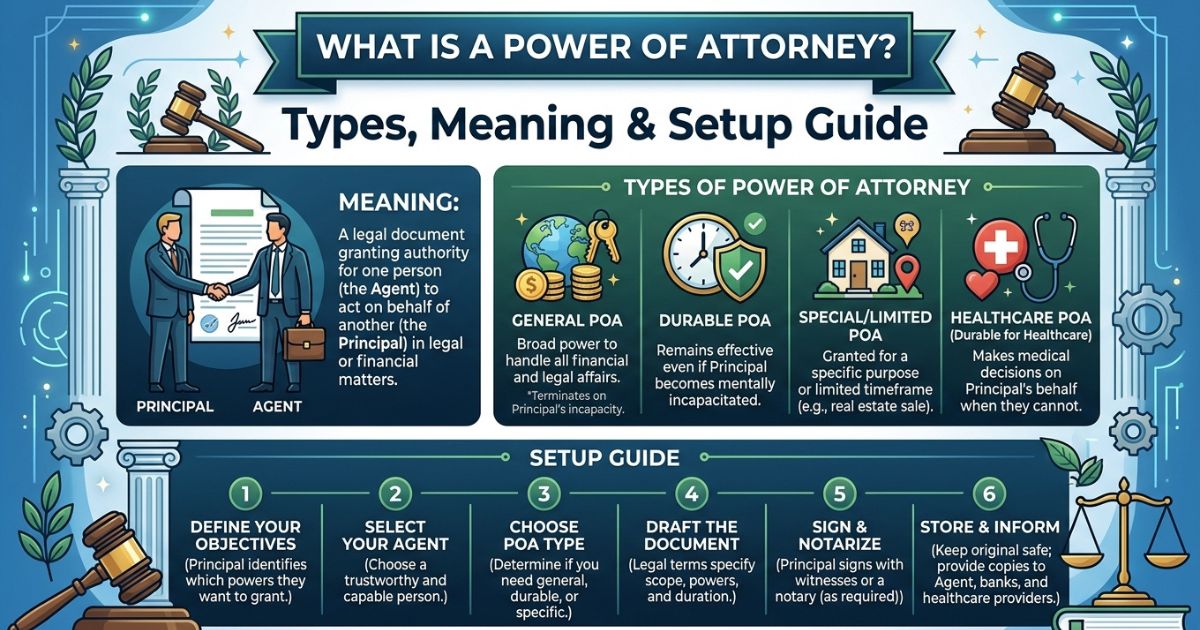
A power of attorney is a legal document that allows one person to authorize another person to act on their behalf. The person granting authority is generally called the principal, donor, or grantor, while the person receiving authority is known as the agent, attorney-in-fact, or attorney.
A power of attorney can cover financial transactions, property, business matters, government filings, healthcare decisions, or a single specified task. Its legal effect depends on the document’s wording and the law of the jurisdiction where it is created or used.
This article explains what a power of attorney is, the main types, how to create one, when it ends, and what safeguards can reduce the risk of misuse. It is for general informational purposes only and does not constitute legal advice.
What Does a Power of Attorney Mean?
In practical terms, a power of attorney lets another person take legally recognized actions for you. For example, an agent may be authorized to:
- Operate or access bank accounts.
- Pay bills and manage household expenses.
- Buy, sell, lease, or maintain property.
- Manage a business or investment account.
- Sign contracts or government documents.
- Handle tax correspondence.
- Make healthcare or personal-care decisions, where local law permits.
The document does not normally transfer ownership of the principal’s assets. Instead, it creates an agency relationship. The agent must act within the authority granted and comply with applicable duties.
The principal usually retains the ability to act personally unless the document or governing law provides otherwise. Giving someone authority to manage a bank account, for instance, generally does not prevent the account holder from continuing to use that account.
Main Types of Power of Attorney
Terminology differs between countries and states. A document called a “lasting power of attorney” in England and Wales may not operate in the same way as a “durable power of attorney” in the United States. The following categories are widely used, but local legal rules control.
General Power of Attorney
A general power of attorney gives broad authority over specified financial, business, or property matters. Depending on its wording, the agent may be able to manage multiple accounts, sign documents, or conduct transactions for the principal.
It is often used for a limited period, such as when the principal is traveling, working abroad, or unable to attend a transaction personally. In many jurisdictions, a general power of attorney ends if the principal loses legal capacity, unless it is expressly made durable or enduring.
Because the authority can be extensive, a general power of attorney should identify the powers granted as clearly as possible. Broad language may create problems if a bank, land registry, court, or other institution questions whether a specific action was authorized.
Special or Limited Power of Attorney
A special power of attorney authorizes one or more specific actions. Common examples include authority to:
- Sell or purchase a particular property.
- Sign closing documents for a real-estate transaction.
- Collect a payment.
- Represent the principal in a defined administrative matter.
- Submit a particular application or government filing.
A limited power of attorney is often more appropriate than a broad document when the principal needs help with only one transaction. It should state the transaction, relevant asset, time period, and any restrictions.
Durable or Enduring Power of Attorney
A durable power of attorney is designed to continue after the principal becomes incapacitated. The precise wording required varies by jurisdiction. Some laws presume durability unless the document states otherwise, while others require express language.
Durability is especially important in incapacity planning. Without a valid durable or enduring authorization, relatives may need to seek a court appointment, such as a guardianship or conservatorship, before they can manage the person’s affairs. Court proceedings can involve petitions, notice to interested parties, medical evidence, hearings, and continuing judicial oversight.
Durability does not mean the agent can act without limits. The agent remains bound by the document, applicable statutes, fiduciary principles, and court orders.
Springing Power of Attorney
A springing power of attorney becomes effective only after a specified event occurs. The triggering event may be incapacity, a medical determination, or another condition stated in the document.
The advantage is that the agent does not receive authority immediately. The disadvantage is that proving the triggering event can delay access to accounts or services. The document should identify who makes the determination, what evidence is required, and how the decision is communicated.
Healthcare or Medical Power of Attorney
A healthcare power of attorney authorizes a person to make medical or personal-care decisions when the principal cannot make or communicate those decisions, subject to local law.
It may address treatment decisions, care facilities, physicians, privacy permissions, and end-of-life preferences. In some jurisdictions, healthcare authority is created through a separate advance directive or healthcare proxy rather than a general financial power of attorney.
A healthcare authorization should be coordinated with written treatment preferences. It is also important to confirm whether hospitals and healthcare systems require a particular form.
Lasting Power of Attorney
In England and Wales, a lasting power of attorney, or LPA, has two distinct forms:
- Property and financial affairs.
- Health and welfare.
An LPA must generally be registered before it can be used. Property and financial affairs LPAs may be structured to operate at different times, while a health and welfare LPA generally becomes relevant when the donor lacks capacity.
This illustrates why readers should not assume that legal terms have identical meanings across jurisdictions.
Tax Power of Attorney
A tax power of attorney is usually limited to dealings with a tax authority. In the United States, Internal Revenue Service Form 2848 authorizes an eligible individual to represent a taxpayer before the IRS for specified tax matters and periods.
Form 2848 is not a substitute for a general financial power of attorney. It is an agency authorization for federal tax matters and must be completed and submitted according to IRS procedures.
How to Set Up a Power of Attorney
The setup process depends on local law, but the core steps are generally similar.
1. Identify the Purpose
Decide whether the authority is needed for finances, property, business, healthcare, taxes, or one specific transaction. Avoid granting broader authority than necessary.
2. Choose the Agent Carefully
The agent should be trustworthy, capable of keeping records, and available when action is required. A principal may appoint one agent, multiple co-agents, or a successor agent, depending on local rules.
Consider whether co-agents must act jointly or may act independently. Joint authority can provide oversight, but it may also make routine transactions slower.
3. Define the Authority
The document should identify:
- The principal and agent.
- The effective date.
- Whether authority is immediate or conditional.
- The powers granted.
- Any prohibited actions.
- Whether gifts, loans, property transfers, or changes to beneficiaries are permitted.
- Whether the document ends on a particular date.
- The successor agent, if any.
Certain powers, such as gifting assets, changing beneficiary designations, creating trusts, or altering rights of survivorship, may require express authorization. A general clause may not be enough.
4. Follow Execution Formalities
Common requirements include the principal’s signature, witnesses, notarization, certification, or registration. The requirements can differ based on the type of document and where it will be used.
Real-estate transactions often require additional recording or authentication. Banks and government agencies may also have internal review procedures, although an institution’s preferred form does not necessarily replace statutory requirements.
5. Provide Copies to Relevant Institutions
The principal should keep the original securely and provide copies to the agent and, where appropriate, banks, doctors, lawyers, accountants, or government agencies. It is prudent to confirm in advance whether the receiving institution requires an original, certified copy, recent document, or specific form.
For tax matters, the relevant tax authority may require its own authorization form rather than a general power of attorney.
What Duties Does an Agent Have?
An agent is not free to use the principal’s property as personal property. Although duties vary by jurisdiction and may be modified in limited ways by the document, common fiduciary obligations include:
- Acting in good faith.
- Staying within the granted authority.
- Following the principal’s known instructions and reasonable expectations.
- Acting in the principal’s best interests.
- Avoiding improper conflicts of interest.
- Keeping accurate records of receipts, payments, and transfers.
- Separating the principal’s funds from the agent’s funds.
- Preserving the principal’s estate plan where legally required and consistent with the principal’s interests.
An agent who exceeds authority or misuses funds may face civil claims, removal, repayment orders, damages, or criminal investigation. Depending on the facts, disputes may proceed through a civil complaint, emergency application, probate or protective proceeding, mediation, settlement, or appeal.
Courts generally examine the document’s wording, the principal’s capacity, the agent’s conduct, financial records, communications, and evidence of coercion, fraud, undue influence, or exploitation.
Risks, Revocation and Legal Disputes
A power of attorney provides convenience but also creates risk because another person may gain access to sensitive financial or personal information. The Consumer Financial Protection Bureau warns that a POA gives an agent substantial financial authority and recommends informing trusted family members and advisers so potential abuse or forgery can be detected.
Warning signs may include unexplained withdrawals, transfers to the agent, unusual property sales, missing records, pressure to sign documents, or refusal to provide account information.
If a principal has capacity, revocation usually requires a written cancellation delivered to the agent and relevant third parties. A new power of attorney may also revoke an earlier document if it says so, but local law controls. Banks and other institutions should be notified promptly.
If a person discovers that a bank or credit union honored a forged power of attorney, the institution should be contacted immediately. Depending on the circumstances, it may also be appropriate to contact law enforcement, adult protective services, a regulator, or a lawyer.
A power of attorney normally ends when:
- The principal revokes it.
- The stated expiration date occurs.
- The purpose is completed.
- The principal dies.
- A court terminates or replaces it.
- The agent resigns and no successor is available.
- The governing law provides another terminating event.
After death, the agent’s authority generally ends. The executor, administrator, or personal representative then acts under the estate process, subject to probate law and court supervision where applicable.
Frequently Asked Questions
Can an agent do anything they want?
No. An agent may act only within the authority granted and must comply with fiduciary duties and applicable law. Unauthorized transfers or self-dealing can result in civil liability and, in serious cases, criminal consequences.
Does a power of attorney mean the agent owns my property?
Usually not. The agent receives authority to act, not automatic ownership. Ownership may change only through a separate valid transaction, such as a deed, sale, gift, or account agreement.
Can a power of attorney be used after death?
Generally, no. Authority typically ends when the principal dies. Estate administration then proceeds through the applicable probate or succession framework.
Can a bank reject a power of attorney?
A bank may review a document and may reject it in circumstances recognized by law, such as suspected forgery, revocation, incapacity at signing, or suspected abuse. In some jurisdictions, institutions that refuse a facially valid document must provide a legally recognized reason.
Is a lawyer required?
Not always. However, professional assistance may be important where the document involves substantial assets, business ownership, family conflict, cross-border property, incapacity planning, gifts, trusts, or healthcare decisions.
Key Takeaway
A power of attorney is a legal authorization that permits an agent to act for a principal. The most important choices concern the scope of authority, when the document takes effect, whether it survives incapacity, and how the agent will be monitored.
Because power of attorney law is jurisdiction-specific, the correct form and signing process should be verified with the relevant court, government office, financial institution, or licensed legal professional.
This article provides general legal information and does not constitute legal advice.
You may also like: Telluride Peaks Resort Colorado Labor Lawsuit: What the Case Involves and Where It Stands