
 By Rightful Advice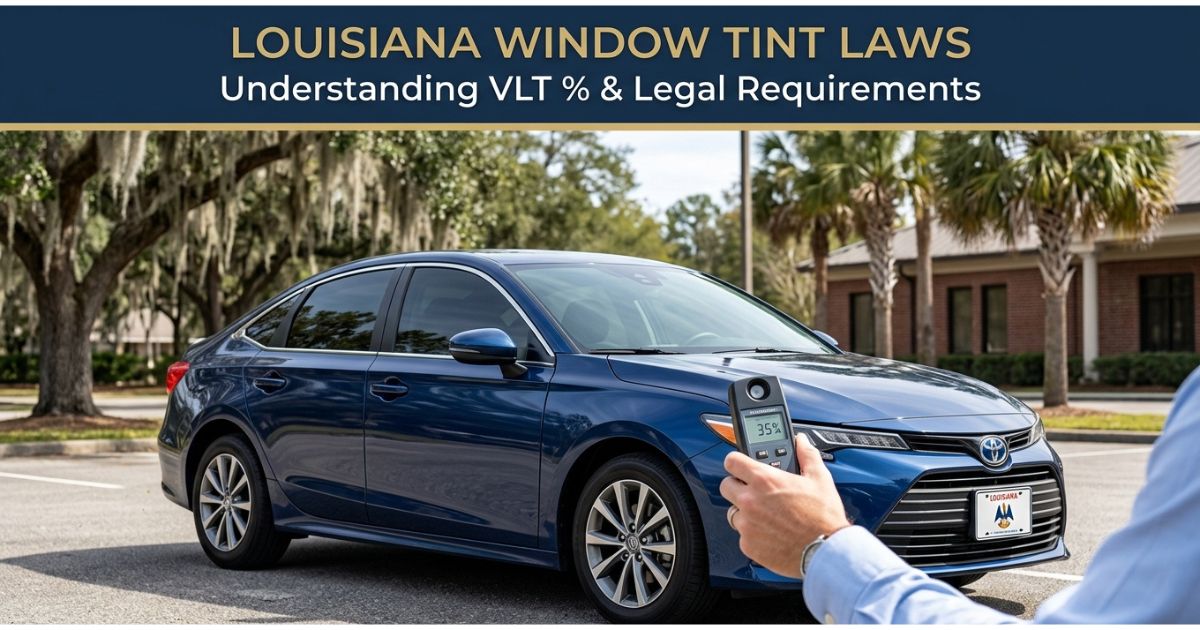
Louisiana’s window tint laws in 2026 set specific minimum Visible Light Transmission (VLT) percentages for each window on a vehicle, with stricter limits on front side windows to preserve law enforcement visibility and driver safety. The core rules are codified in the Louisiana Revised Statutes (R.S.) 32:361.1 and 32:361.2, enforced by the Louisiana State Police and local law enforcement.
What are the legal tint limits in Louisiana?
Louisiana law defines legal tint darkness by window position and, in some cases, by vehicle type. The key metric is VLT, which measures the percentage of visible light that passes through the glass and film combined.
Passenger cars (sedans, coupes, typical cars)
For standard passenger vehicles, Louisiana requires:
- Front windshield: No tint is allowed on the main area. A non-reflective tint strip is permitted only along the top, above the manufacturer’s AS-1 line.
- Front side windows (driver and front passenger): At least 40% VLT. This means the film and glass together must allow 40% or more of visible light to pass through.
- Rear side windows: At least 25% VLT.
- Rear window (back glass): At least 12% VLT.
Some installer guides and legal summaries phrase this as “40% front, 25% back sides, 12% rear,” which aligns with the statutory framework and the Louisiana State Police exemption form.
SUVs and vans
Louisiana treats SUVs and vans more permissively for rear windows:
- Front side windows: Still must meet the 40% VLT minimum.
- Rear side windows and rear window: May be any darkness (no specific VLT floor), provided other restrictions on reflectivity and color are met.
This distinction matters in practice: a sedan owner who installs “limo tint” (for example, 5% VLT) on rear side windows would be out of compliance, while an SUV or van owner may legally use much darker film on those same positions.
Reflectivity and color restrictions
Beyond darkness, Louisiana law also limits how reflective tint can be:
- Tint on any window must not be more reflective than a standard, untinted window.
- Certain colors (often red, amber, and similar hues that could be confused with emergency vehicles) are restricted or prohibited under state equipment rules, consistent with broader vehicle lighting and equipment statutes.
These rules are designed to prevent glare for other drivers and avoid confusion with official vehicles.
The legal basis: R.S. 32:361.1 and related statutes
Louisiana’s window tint rules are grounded in R.S. 32:361.1, which governs the use of sun screening devices and other materials on windshields and windows. The statute prohibits placing any material on the front windshield or front side windows that obstructs or reduces the driver’s clear view, or that alters color or reduces light transmission below legal thresholds.
Key principles from the statutory scheme include:
- Obstruction prohibition: No object or material may be affixed to the front windshield or front side windows in a way that obstructs or reduces the driver’s clear view.
- Light transmission standards: Transparent materials that reduce light transmission below the prescribed VLT levels are not permitted on regulated windows.
- Medical exemption carve-out: R.S. 32:361.2 creates an exception for individuals with documented medical conditions that require greater sun protection.
In enforcement terms, this means an officer can lawfully stop a vehicle if the tint appears to violate these visibility and light transmission standards, then issue a citation or require removal of non-compliant film.
Enforcement, fines, and what happens if you’re cited
Louisiana treats illegal window tint as a traffic equipment violation. In practice, enforcement typically follows a standard pattern seen in many states:
- An officer observes a vehicle with tint that appears too dark or reflective.
- The officer conducts a traffic stop and may measure or visually assess the tint.
- If the tint is deemed illegal, the driver receives a citation under the relevant equipment statute.
Typical fines for tint violations
Multiple legal and consumer guides report the following fine structure for Louisiana window tint violations:
- First offense: Up to $150
- Second offense: Up to $250
- Third or subsequent offense: Up to $350
These amounts can vary slightly by parish or court, but they reflect the commonly cited statutory or local penalty ranges for equipment violations tied to tint.
Beyond fines: practical consequences
In real-world terms, a tint ticket can create more than just a fine:
- Mandatory correction: Courts or law enforcement may require you to remove or replace the illegal tint before the case is closed.
- Inspection issues: While Louisiana does not have a universal annual safety inspection program for all vehicles, illegal equipment can still cause problems during certain inspections, resale, or if the vehicle is scrutinized after an accident.
- Insurance and accident implications: Although tint alone rarely determines fault in a crash, insurers and investigators may note illegal modifications when evaluating claims, especially if visibility is argued to be a factor.
Recent local commentary has also highlighted increased attention to tinted windows and plate covers as part of broader traffic safety and enforcement efforts, suggesting that illegal tint may draw more scrutiny in some jurisdictions.
Medical exemptions: when darker tint is legally allowed
Louisiana law recognizes that some individuals have medical conditions that make standard tint limits unsafe or impractical. Under R.S. 32:361.2, a person with a qualifying physical or medical condition may obtain an exemption allowing darker tint than normally permitted.
Who qualifies?
The statute and related guidance indicate that qualifying conditions generally involve significant sensitivity to sunlight or specific dermatological or ocular disorders. Examples commonly cited include:
- Lupus and other autoimmune conditions with photosensitivity
- Porphyria
- Albinism
- Certain forms of skin cancer or pre-cancerous conditions
- Severe photophobia or light-sensitive eye disorders
The law references conditions verifiable under the World Health Organization’s International Classification of Diseases (ICD-9-CM), meaning the diagnosis must be a recognized medical condition that can be documented using standard codes.
How the exemption process works
In practice, obtaining a medical window tint exemption in Louisiana involves several steps:
- Medical evaluation: A licensed physician, optometrist, ophthalmologist, or dermatologist evaluates the patient and determines that sun exposure poses a significant health risk.
- Affidavit or certification: The provider completes a state form (often referred to as a Window Tint Medical Exemption Affidavit, such as Form DPSSP 1060) or provides a detailed letter on official letterhead.
- The document must state the diagnosis, explain why reduced light transmission is medically necessary, and often specify the recommended VLT level.
- Submission to authorities: The completed, often notarized, form is submitted to the Louisiana State Police or the designated state agency handling tint exemptions.
- Issuance of exemption certificate: If approved, the state issues a medical exemption certificate or sticker that must be kept in the vehicle and displayed as instructed.
- Renewal and limits: Exemptions are typically time-limited (for example, three years) and non-transferable, meaning they apply to the individual and often to a specific vehicle.
Importantly, the exemption does not give carte blanche to ignore all rules. Reflectivity limits and certain color restrictions may still apply, and the documentation must be carried in the vehicle in case of a stop.
How Louisiana’s rules compare to other states
Louisiana’s tint laws sit in the middle of the national spectrum:
- Front side windows at 40% VLT are more permissive than strict states like Pennsylvania (which effectively requires more than 70% VLT on front windows) but stricter than states that allow 25% or 35% on front side windows.
- Rear windows at 12% VLT for sedans and unlimited darkness for SUVs/vans are relatively lenient, aligning Louisiana with many Southern and Western states that allow very dark rear glass.
For drivers who travel across state lines, this creates a compliance risk: a tint setup that is legal in Louisiana may be illegal in a neighboring state with stricter front-window limits.
Practical tips for staying compliant with Louisiana tint laws
If you are considering tint or have recently been cited, these steps can help you align with Louisiana tint laws and reduce legal risk:
- Confirm VLT before installation: Ask your installer to measure and document the VLT of both the glass and the film. Many shops use a tint meter to ensure the combined percentage meets or exceeds legal minimums.
- Distinguish vehicle type: Verify whether your vehicle is classified as a passenger car, SUV, or van under Louisiana law, since rear-window limits differ.
- Avoid reflective and colored films: Choose non-reflective, neutral-colored tints to stay within equipment rules and avoid additional citations.
- Keep medical paperwork accessible: If you have a medical exemption, carry the certificate and any supporting physician documentation in the vehicle at all times.
- Respond promptly to citations: If you receive a tint ticket, address it quickly. In many cases, correcting the tint and providing proof of compliance can reduce or dismiss fines, depending on the court.
Frequently asked questions about Louisiana tint laws
Is 35% tint legal on front windows in Louisiana?
No. Louisiana requires at least 40% VLT on front side windows for passenger vehicles, SUVs, and vans. A 35% tint would be below the legal limit and could result in a citation.
Can I tint my windshield in Louisiana?
You may not tint the main area of the windshield. Only a non-reflective strip along the top, above the AS-1 line, is permitted.
Do SUVs and vans have different tint rules?
Yes. While front side windows must still meet the 40% VLT minimum, rear side windows and the rear window on SUVs and vans may be any darkness, unlike sedans, which must meet 25% and 12% VLT minimums, respectively.
Are medical exemptions available for darker tint?
Yes. Under R.S. 32:361.2, individuals with qualifying medical conditions can obtain a medical exemption allowing darker tint, including on front side windows, if properly documented and approved by the state.
What are the fines for illegal tint in Louisiana?
Typical fines are up to $150 for a first offense, $250 for a second, and $350 for a third or subsequent offense, though local courts may vary slightly.
Important legal disclaimer
This article is for informational purposes only and does not constitute legal advice. Window tint laws and enforcement practices can change, and local courts or parishes may interpret or apply statutes differently. For advice about your specific situation, including pending citations or medical exemption applications, consult a qualified Louisiana attorney or contact the Louisiana State Police or Office of Motor Vehicles directly.
You may also like: What Is a Power of Attorney? Types, Meaning, and Setup Guide