
 By Rightful Advice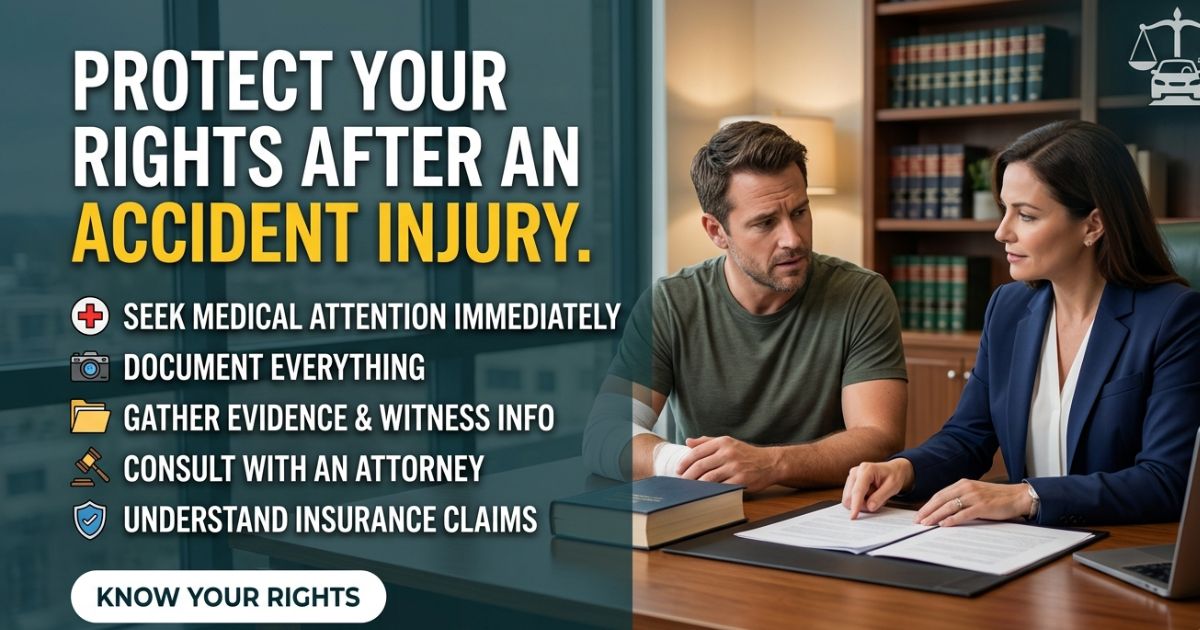
The moments, days, and weeks following a severe accident injury are a critical defining period for your physical and financial future. While your primary focus must understandably be on healing, you must also recognize that an invisible clock has started ticking. Insurance companies representing the negligent party waste no time; they deploy claims investigators and adjusters almost immediately to find ways to devalue, delay, or completely deny your legitimate right to compensation.
If you are unprepared, it is remarkably easy to make an innocent mistake that permanently damages your legal claim. Protecting your rights does not require an advanced law degree, but it does require a proactive, highly strategic approach to managing your medical care, communications, and evidence. By implementing these seven smart, legally sound strategies, you can effectively shield your injury claim from corporate interference and build an unassailable case for financial justice.
1. Establish an Unbroken Medical Chain of Care Immediately
The absolute cornerstone of protecting your legal rights is securing a comprehensive medical evaluation within 24 hours of the accident, followed by strict adherence to your doctor’s treatment protocols.
Eliminating the “Gap in Treatment” Defense
If you delay seeking medical care for days or weeks, or if you consistently skip scheduled physical therapy appointments, you create a gap in treatment. Insurance adjusters track these gaps meticulously. They will argue that if you were genuinely experiencing severe physical pain, you would have sought immediate, consistent care. They will use this timeline to claim your injuries are either completely fabricated, heavily exaggerated, or were caused by an entirely separate incident that happened after the accident.
Documenting Every Physiological Damage
When you visit an emergency room, urgent care clinic, or primary physician, detail every single symptom you are experiencing, no matter how minor it may seem at the time. A mild headache can be an early sign of a traumatic brain injury (concussion), and slight neck stiffness can quickly develop into chronic whiplash. If a symptom is not written down in your initial official medical records, proving it was a direct result of the accident becomes an uphill battle.
2. Secure a Certified Copy of the Official Law Enforcement Report
An official police or incident report is a highly influential piece of documentation that insurance companies utilize to make preliminary assessments of legal liability.
Forcing the Presence of Authorities
Never agree to settle an accident privately with the at-fault party without involving law enforcement or building management. At a traffic accident scene, call 911 and wait for an officer to arrive. They will interview both parties, speak with neutral bystanders, examine physical debris, and document citations issued for safety violations.
Reviewing the Report for Factual Errors
Once the police report is finalized and filed into the public system—usually within 5 to 7 business days—request a certified copy through your local police department or your attorney. Read through the narrative and diagram carefully. If you discover a significant factual error, such as an incorrect date, an omitted witness, or an inaccurate vehicle insurance policy number, your lawyer can submit an official supplement request to correct the public record.
3. Limit Your Communication with Corporate Insurance Adjusters
The at-fault party’s insurance adjuster will likely contact you within a few days of the accident. They often sound deeply empathetic, warm, and eager to help you process your claim quickly.
The Hidden Trap of the Recorded Statement
Do not let their friendly demeanor lower your guard. Adjusters are corporate professionals trained to ask structured, misleading, or open-ended questions designed to elicit answers that damage your claim. A polite response like “I’m doing okay today, thank you” can be legally weaponized later to argue that your physical suffering is minimal.
Refusing to Discuss Injuries Over the Phone
You are under absolutely no legal obligation to give a recorded statement or sign unrestricted medical authorization forms for the other party’s insurer. Politely inform the adjuster that you are focusing entirely on your medical recovery and that your personal injury attorney will handle all future direct communications.
4. Implement a Strict Post-Accident Social Media Blackout
In the modern digital landscape, insurance defense teams and private investigators routinely monitor the public and private social media profiles of personal injury plaintiffs.
The Misconstruction of Digital Evidence
You might post an innocent photo of yourself smiling at a family dinner, sitting at a coffee shop, or celebrating a holiday. To a jury or an insurance company, that single static image will be stripped of its context and presented as definitive proof that your life is normal, your pain is non-existent, and you are not genuinely suffering.
Deactivating Tagging Options and Pausing Updates
The smartest way to protect your rights is to implement a complete social media blackout while your injury claim is active. Stop posting status updates, do not check into physical locations, do not upload old photos that could be mistaken for current activities, and explicitly instruct your close friends and family members not to tag your account in any of their personal posts.
5. Meticulously Track All Financial Losses and Out-of-Pocket Expenses
To maximize your ability to recover full compensation, you must maintain a pristine, highly organized paper trail of every single dollar the accident has cost you.
Creating a Dedicated Expense Archive
Set aside a secure physical folder or encrypted digital drive to serve as your master financial archive. Collect and organize:
- Every medical bill, co-pay invoice, and pharmaceutical receipt.
- Invoices for vehicle towing, body shop repairs, and rental car fees.
- Receipts for over-the-counter medical equipment, such as crutches or braces.
- Invoices for hiring household help, such as landscaping or cleaning services, if your injuries prevent you from performing these standard chores.
Documenting Lost Wages and Income Disruption
Obtain an official wage verification letter from your employer’s human resources or payroll department. This document must explicitly outline your standard hourly wage or salary, the precise number of work hours you missed due to your medical recovery, and the total gross value of the income you lost during that period.
6. Preserve and Maintain an Active Daily Injury Journal
While financial receipts quantify your economic damages, a detailed narrative journal is the most effective way to validate your non-economic damages, commonly referred to as pain and suffering.
Tracking Qualitative Impact in Writing
Dedicate a physical notebook or a secure note-taking app to serve as your daily injury diary. Every single day, make brief entries documenting:
- Your daily pain levels on a structured scale of 1 to 10.
- The specific nature of your physical symptoms (e.g., sharp back spasms, radiating leg numbness).
- Sleep disruptions, nightmares, or severe post-accident anxiety.
- Specific personal activities, hobbies, or family milestones you missed because of your physical limitations.
Establishing Long-Term Behavioral Context
Memories fade rapidly over the months it takes to resolve a personal injury lawsuit. A comprehensive journal serves as a historical record that allows you to provide precise, highly credible testimony during legal depositions or in front of a jury trial.
7. Retain a Dedicated Personal Injury Attorney Early in the Process
Attempting to navigate complex civil statutes, filing deadlines, and aggressive insurance defense strategies on your own is an uphill battle that leaves you highly vulnerable.
Leveling the Legal Playing Field
Hiring an elite Personal Injury Lawyer Tyrone immediately levels the playing field. Your attorney will take over all stressful administrative logistics, issue formal spoliation letters to preserve decaying evidence (such as commercial security footage), consult with accident reconstruction specialists, and handle all direct negotiations with the insurance company.
Understanding the Financial Safeguard of Contingency Fees
Reputable personal injury lawyers operate on a contingency fee basis. This means you face absolutely zero upfront retainers, zero out-of-pocket costs, and zero hourly legal fees. Your attorney only receives payment if they successfully secure a financial settlement or a winning jury verdict on your behalf, ensuring you can access top-tier legal protection without financial risk.
Frequently Asked Questions (FAQs)
1. What happens if the at-fault driver’s insurance company denies my injury claim?
If the insurance company completely denies your claim or refuses to offer a fair settlement, your personal injury attorney will file a formal civil lawsuit in court against the negligent party. This initiates the discovery phase, allowing your lawyer to subpoena corporate records, take depositions under oath, and prepare your case to be decided by a judge and jury at a formal trial.
2. Can I safely talk to my own auto insurance company after a crash?
Yes, you generally have a contractual obligation to report an accident to your own insurance provider within a reasonable timeframe. However, you should stick purely to the basic facts: the date, time, location, and the contact information of the other drivers. Do not speculate about fault, do not guess the speed of the vehicles, and do not make definitive statements about your injuries until you have been fully evaluated by a physician.
3. What is a “Spoliation Letter” and why is it important?
A spoliation letter is a formal legal notice sent by your attorney to a potential defendant demanding that they preserve all physical and electronic evidence relevant to the accident. For example, if you were injured in a retail slip and fall, this letter legally bars the business from overwriting their security camera footage or destroying maintenance logs. If they destroy the evidence after receiving this letter, the court can penalize them severely at trial.
4. What should I do if my health insurance company refuses to pay for my accident treatments?
If your health insurance provider hesitates to cover your treatments because a third party caused your injuries, your attorney can step in to clarify that your health coverage must pay for your immediate medical care. Your health insurer will typically place a medical lien on your eventual personal injury settlement, allowing them to be reimbursed out of your final financial recovery once your lawsuit concludes.
5. How long do I have to take legal action after an injury in most states?
The time limit to file a formal lawsuit is governed by a law called the statute of limitations. This deadline varies significantly by state, ranging from one to four years from the exact date of the accident. If you miss this strict statutory deadline, your legal right to pursue financial compensation for your injuries is permanently extinguished.
Conclusion
Protecting your rights after an accident injury requires a disciplined combination of swift medical action, intentional silence with insurance adjusters, comprehensive physical documentation, and early legal intervention. Insurance companies rely heavily on your shock, exhaustion, and lack of legal experience to devalue your claim. By prioritizing immediate medical care, keeping your personal life off social media, maintaining a detailed financial paper trail, and hiring an elite personal injury attorney, you can assert your rights, block corporate tactics, and secure the full compensation you deserve.