
 By Rightful Advice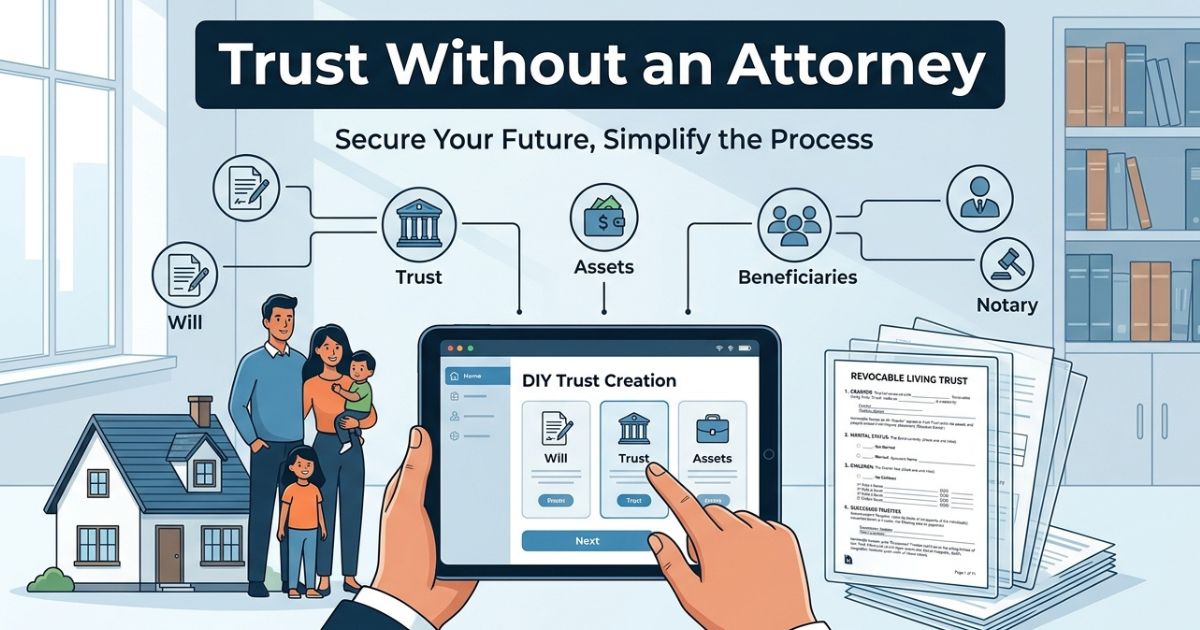
Yes, you can set up a trust without an attorney in every U.S. state. No statute requires a lawyer to draft, sign, or witness a trust document. However, whether a DIY trust is advisable depends on your assets, family situation, and the legal complexity of your goals. This article explains the legal requirements for creating a valid trust, the risks of do‑it‑yourself (DIY) documents, and when hiring an estate planning attorney is the safer choice.
Important: This article is for informational purposes only and does not constitute legal advice. Trust and estate laws vary by state. For advice about your specific situation, consult a licensed attorney in your jurisdiction.
Background & Legal Context
Trusts are private legal arrangements used to hold and manage property for the benefit of designated persons or purposes. In estate planning, the most common type is the revocable living trust, which allows the creator (the settlor or grantor) to retain control during life and direct how assets pass at death, often avoiding probate.
The Uniform Trust Code and State Variations
Most states have adopted some version of the Uniform Trust Code (UTC), a model statute that standardizes core trust rules. Under UTC § 402, a trust is created only if five elements are satisfied:
- Capacity: The settlor has legal capacity to create a trust (generally the same standard used for wills).
- Intent: The settlor clearly indicates an intention to create a trust.
- Definite beneficiary (or exception): The trust has an identifiable beneficiary, or qualifies as a charitable trust, an animal‑care trust, or a noncharitable purpose trust.
- Trustee duties: A trustee is named and has enforceable duties to perform.
- No merger: The same person is not both the sole trustee and the sole beneficiary.
States that have enacted the UTC (or similar codes) codify these requirements in their statutes. Examples include Massachusetts (M.G.L. c. 203E, § 402), Ohio (R.C. 5804.02), Virginia (Code § 64.2‑720), and North Carolina (N.C.G.S. § 36C‑4‑402).
Writing, Signing, and Notarization
While some jurisdictions recognize oral trusts under narrow circumstances, the modern rule (and UTC approach) strongly favors written instruments to prove intent and terms. Many states require or strongly recommend notarization and, for real estate transfers, recording of deeds reflecting the trust ownership. Failure to follow state execution formalities can create evidentiary problems or invalidate transfers.
Key Legal Issues Explained
DIY Trusts Are Legally Permissible
There is no law that says a trust must be prepared by an attorney. A DIY living trust can be legally valid if it is properly drafted, signed, and funded according to your state’s laws. Online templates and software can produce enforceable documents for straightforward situations.
That said, validity on paper is different from effectiveness in practice. Courts and trustees apply the same statutory standards to DIY trusts as to attorney‑drafted trusts. If a DIY document fails any of the UTC § 402 elements, or if assets are not correctly transferred into the trust, the plan may not work as intended.
Common DIY Pitfalls That Can Void or Undermine a Trust
Legal practitioners and probate courts frequently encounter the following errors in self‑prepared trusts:
- Failure to fund the trust: The single most common mistake. Assets must be retitled into the trust’s name (or coordinated via beneficiary designations). Unfunded assets remain part of your probate estate, defeating the main purpose of a living trust.
- Incorrect or incomplete trustee provisions: Naming an ineligible trustee (for example, someone under 18 or lacking capacity), omitting successor trustees, or using ambiguous language about trustee powers can stall administration.
- Wrong trust type or irrevocability trap: Using language that accidentally creates an irrevocable trust when a revocable trust was intended can lock you out of future changes and trigger unintended tax or Medicaid consequences.
- State‑law mismatches: Boilerplate forms may not reflect current state statutes on signing, witnessing, notarization, or specific clauses (for example, spendthrift or decanting provisions).
- Tax and public‑benefits planning gaps: DIY documents often overlook estate tax, income tax, or Medicaid eligibility rules. For example, a revocable trust does not protect assets from Medicaid’s resource test; only certain irrevocable structures do, and they must be funded well in advance.
- Ambiguous beneficiary designations: Vague or outdated beneficiary language can lead to disputes, litigation, or distributions that contradict your intent.
When an Attorney Adds Clear Value
An experienced estate planning attorney does more than fill in blanks. Attorneys typically:
- Confirm capacity and intent in a way that withstands challenges.
- Select the correct trust type (revocable vs. irrevocable; Medicaid asset protection trust; special needs trust; etc.).
- Draft precise trustee powers, successor provisions, and distribution schemes.
- Coordinate beneficiary designations on retirement accounts and life insurance.
- Plan for tax efficiency and public‑benefits eligibility where relevant.
- Provide a funding checklist and assist with deeds, assignments, and account transfers.
For complex families, business interests, blended families, special needs beneficiaries, or significant assets, the risk of costly errors rises sharply without professional guidance.
Latest Developments or Case Status
Trust law remains primarily state‑based, but the Uniform Trust Code continues to shape modern practice. Most enacting states have modified certain UTC sections over time, especially provisions on trust modification and termination, creditor rights against revocable trusts, trustee reporting duties, and spendthrift protections. These variations matter for DIY planners because a template based on one state’s UTC version may not align with another state’s enacted text.
In parallel, consumer‑focused legal technology has expanded access to DIY estate planning tools. While these services can reduce cost, they do not eliminate the need to comply with state‑specific execution and funding rules. Probate courts continue to see cases where unfunded or improperly drafted trusts force families into probate despite the existence of a trust document.
Who Is Affected & Potential Impact
Consumers and Families
- DIY users: May save on upfront legal fees but risk probate, delays, or unintended distributions if the trust is invalid or unfunded.
- Families of DIY settlors: May face higher administrative costs, litigation over ambiguous terms, or loss of asset protection if the trust fails.
- Older adults and Medicaid applicants: Using the wrong trust type can jeopardize eligibility. Revocable trusts do not shield assets from Medicaid; only properly structured irrevocable trusts can, and only after the applicable look‑back period.
Businesses and Institutions
- Financial institutions and title companies: Require precise documentation to retitle accounts and real property into a trust. Defective instruments can delay transfers or be rejected outright.
- Courts and fiduciaries: Ambiguous or noncompliant trusts increase the likelihood of court intervention, trustee disputes, and higher administration costs.
What This Means Going Forward
For straightforward estates with modest assets and simple family structures, a carefully completed DIY trust that meets state law can be a reasonable option. For anyone with real estate in multiple states, business interests, blended families, special needs beneficiaries, or concerns about taxes or Medicaid, the legal and financial stakes justify hiring an attorney.
Readers should monitor:
- Updates to their state’s trust code (especially UTC‑derived sections on modification, creditor rights, and trustee duties).
- Changes in Medicaid rules and look‑back periods that affect asset protection planning.
- Court decisions in their jurisdiction addressing trust capacity, funding, and interpretation, which can affect how DIY documents are treated.
Frequently Asked Questions
1. Can you set up a trust without an attorney?
Yes. No state requires an attorney to create a trust. A DIY trust can be valid if it satisfies statutory requirements (capacity, intent, definite beneficiary, trustee duties, no merger) and is properly executed and funded under state law.
2. What are the legal requirements to create a valid trust?
Under the Uniform Trust Code § 402, a trust requires: (1) a settlor with capacity; (2) clear intent to create a trust; (3) a definite beneficiary (or a qualifying charitable/animal/noncharitable purpose trust); (4) a trustee with duties; and (5) no merger of sole trustee and sole beneficiary. States codify similar rules in their own statutes.
3. Does a DIY trust avoid probate?
Only if it is properly funded. A living trust avoids probate only for assets actually titled in the trust’s name or correctly coordinated through beneficiary designations. Unfunded assets remain part of your probate estate.
4. When should I hire an attorney instead of using a DIY trust?
Consider an attorney if you have real estate in multiple states, business interests, blended or complex family dynamics, special needs beneficiaries, significant assets, or goals involving tax planning or Medicaid eligibility. These scenarios increase the risk of costly errors with DIY documents.
5. What are the biggest DIY trust mistakes?
The most common are failure to fund the trust, naming ineligible or ambiguous trustees, omitting successor trustees, using the wrong trust type (accidentally irrevocable), and relying on boilerplate language that conflicts with state law. These mistakes can force probate or trigger unintended tax and benefits consequences.
6. Do I need to notarize a trust document?
Many states do not strictly require notarization for validity, but notarization is strongly recommended and sometimes required for related documents (such as deeds). Notarization helps prove authenticity and can ease acceptance by banks and title companies. Always check your state’s execution rules.
Conclusion
The short answer to “can you set up a trust without an attorney” is yes. The more important question is whether a DIY trust will reliably achieve your goals under your state’s law and with your specific assets and family situation. For simple estates, a well‑executed DIY trust can work. For anything more complex, the cost of an attorney is often small compared to the expense and stress of correcting a failed plan.
Disclaimer: This article is for informational purposes only and does not constitute legal advice. Laws vary by state and change over time. Consult a licensed attorney in your jurisdiction for advice about your particular circumstances.
You may also like: Louisiana Window Tint Laws (2026): Legal VLT % & Rules