
 By Rightful Advice
Few questions carry more emotional weight than “Is this my child?” or “Will my child’s father ever be part of their life?” Whether you are a father who wants a real role in your child’s future or a mother who needs support and stability, paternity is often where that journey begins.
I have practiced family law in Texas since 1993, and as a board-certified specialist I have seen how much confusion surrounds this area. Many parents assume that being the biological father, or simply being involved in a child’s life, settles everything. It often does not. This guide explains in plain English how paternity works under Chapter 160 of the Texas Family Code, what rights it creates, and what steps to consider. It is general information, not legal advice for your situation.
What Does Paternity Mean in Texas, and Why Does It Matter?
Paternity is the legal relationship between a father and his child. Biology matters, but in Texas the legal relationship must be established in a way the Family Code recognizes. Once it is, the parent-child relationship applies for all purposes unless parental rights are later terminated (§ 160.203).
When parents are not married, the child’s mother is the legal parent from birth, but the father generally is not until paternity is established. Until then, he has no court-enforceable right to make decisions for the child or to spend time with the child, and the child has no court-ordered support from him.
Establishing paternity protects everyone involved:
- The child gains a legal right to financial support, health insurance, and potential inheritance, plus access to family medical history.
- The father gains standing to ask the court for conservatorship rights and a parenting schedule.
- The mother gains a path to court-ordered child support and a clear legal framework for co-parenting.
When Does Texas Presume a Man Is the Father?
In some situations, Texas law assumes a man is the father without any court order. Under § 160.204, a man is a “presumed father” if, for example:
- He is married to the mother and the child is born during the marriage.
- The child is born within 300 days after the marriage ends by death, annulment, or divorce.
- He married the mother after the child was born and voluntarily asserted paternity, such as by being named on the birth certificate with his consent or promising in a record to support the child as his own.
- During the first two years of the child’s life, he continuously lived in the same household as the child and represented to others that the child was his own.
A presumption is powerful, but it is not always the final word. It can be rebutted through a court adjudication or a valid denial of paternity filed together with another man’s acknowledgment. This is why married couples sometimes need paternity addressed in a divorce, especially when a child was born during a separation.
What Is an Acknowledgment of Paternity?
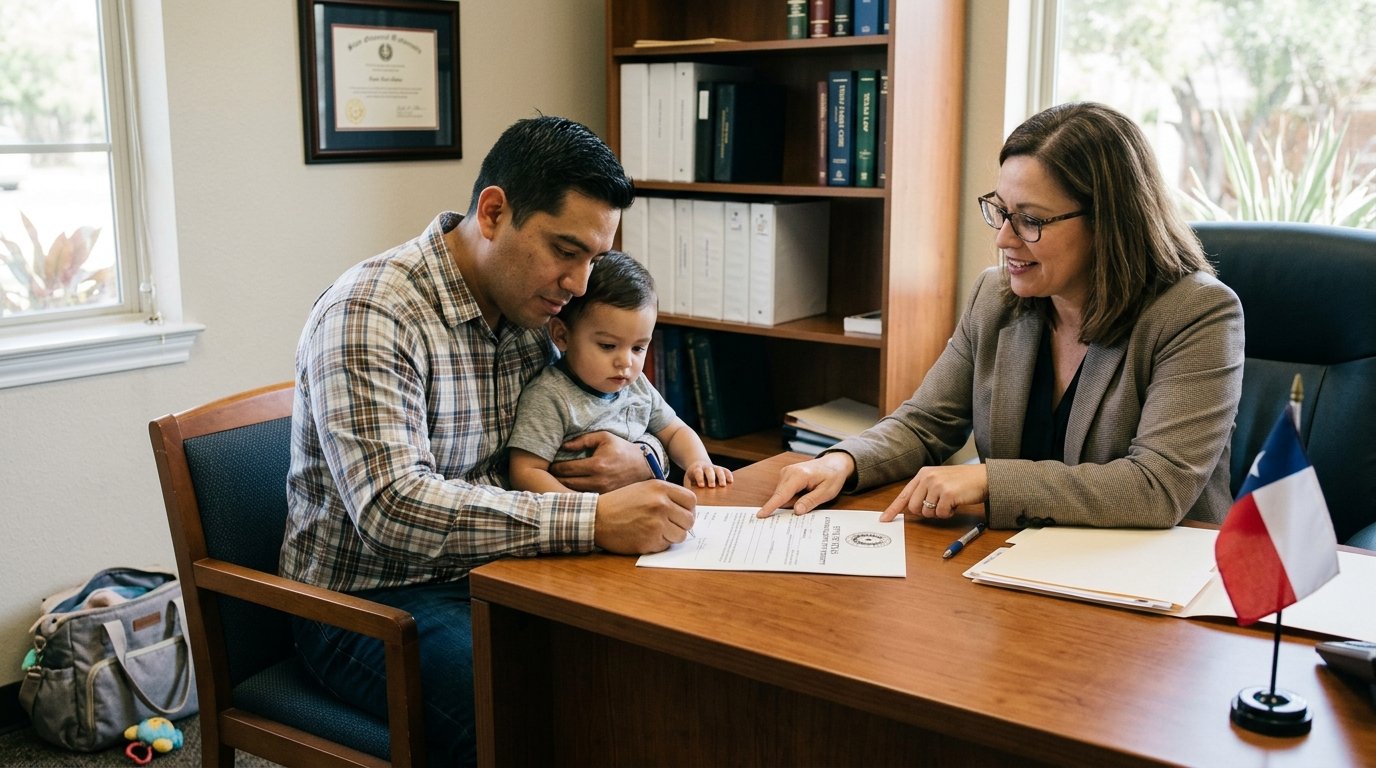
For unmarried parents who agree on who the father is, the simplest path is often an Acknowledgment of Paternity, commonly called an AOP. It is a legal form both parents sign, often at the hospital after the birth, and file with the Texas Vital Statistics Unit. There is no filing fee (§ 160.306).
An AOP is not a casual piece of paperwork. A valid, filed acknowledgment is the equivalent of a court adjudication of paternity (§ 160.305). It becomes effective on the child’s birth or the date it is filed, whichever is later (§ 160.304).
The law gives very limited room to undo it:
- Rescission: Either signer may rescind before the earlier of the 60th day after the AOP becomes effective or the date a court case about the child, including a child support case, is filed in which the signer is a party (§ 160.307).
- Challenge: After that window closes, a signer may challenge the AOP only on the basis of fraud, duress, or material mistake of fact, and only before any order affecting the child is issued, including a child support order. Genetic testing that excludes the man who signed counts as a material mistake of fact (§ 160.308).
My advice is simple: if there is any doubt about biology, ask for genetic testing before signing. It is far easier to answer the question first than to unwind an acknowledgment later.
How Does a Court Establish Paternity?
When parents disagree, or when one parent will not sign an AOP, either parent can file a suit to adjudicate parentage. The Texas Office of the Attorney General can also bring these cases as part of its child support work.
Genetic testing is usually at the center of the case. The court can order testing, and under § 160.505 a man is rebuttably identified as the father when the results show at least a 99% probability of paternity and a combined paternity index of at least 100 to 1. Results from an accredited lab carry real weight, so the outcome often becomes clear quickly.
Timing matters, and the deadlines depend on the child’s situation:
- No presumed, acknowledged, or adjudicated father: A suit to establish paternity can be filed at any time (§ 160.606).
- A presumed father exists: A suit to adjudicate the parentage of that child generally must be filed by the child’s fourth birthday, with two exceptions: when the presumed father and mother did not live together or have sexual relations during the probable time of conception, or when the presumed father missed the deadline because misrepresentations led him to believe he was the biological father (§ 160.607).
Those exceptions are narrow and fact-specific. If you believe a presumed father is not the biological father, talk with an attorney early rather than waiting.
What Happens After Paternity Is Established?
Establishing paternity answers who the father is. It does not, by itself, set a parenting schedule or a support amount. Those questions are decided in the same case or a related one, using the same standards that apply in a divorce. The child’s best interest remains the court’s primary consideration (§ 153.002).
- Conservatorship: the rights and duties to make decisions about the child’s education, health care, and primary residence. Texas presumes that naming both parents joint managing conservators is in the child’s best interest, unless a history of family violence between the parents removes that presumption (§ 153.131).
- Possession and access: the parenting schedule. Many families use the Standard Possession Order, but parents can agree to a schedule that fits their lives.
- Child support: calculated under the Chapter 154 guidelines, which since September 1, 2025, apply to the first $11,700 of the paying parent’s monthly net resources.
Retroactive support is often the surprise. When paternity is established after a child’s birth, the court may order support for past periods. Under § 154.131, an award limited to what would have been due for the four years before the petition was filed is presumed reasonable, and a court can go further in some cases, such as when the father knew or should have known he was the father and avoided a support obligation.
Does a Paternity Case Have to Become a Courtroom Fight?
Usually not, and it should not start as one. Most paternity cases are not really about whether someone is the father. Once genetic testing answers that question, the real work is building a parenting plan and a support arrangement both parents can live with for years.
That is why I start from a settlement-first posture. Negotiation and mediation let parents shape a schedule around school, work, and the child’s needs, instead of handing those decisions to a judge. A scorched-earth approach in a paternity case tends to damage the very co-parenting relationship the child will depend on.
Settlement-first does not mean settlement at any cost. If a parent refuses testing, hides income, or creates a safety concern for the child, you need an attorney prepared to take the case to trial. Local courtroom insight helps too. Cutrer Law Group limits its practice to Tarrant County and surrounding areas, and knowing how the local family courts handle these cases helps us set realistic expectations from the first meeting.
What Steps Should You Take Now?
Whether you are a mother or a father, a few practical steps can protect your position and your child:
- Don’t sign an AOP if you have doubts. Ask for genetic testing first.
- Consider the paternity registry. A man who wants notice of a possible adoption of, or termination of parental rights to, a child he may have fathered can register with the Texas Vital Statistics Unit before the birth or within 31 days after it (§ 160.402).
- Keep records. Save texts, emails, receipts for support you have provided, and notes about time spent with the child.
- Stay involved. Consistent, documented involvement in your child’s life matters when a court considers best interest.
- Don’t wait. Some deadlines are strict, and retroactive support can grow the longer a case goes unfiled.
- Keep conflict off social media. Posts about the other parent rarely help and are often used as evidence.
You do not have to have every document in order before you call an attorney. A good lawyer will help you figure out what matters most for your situation.
Building a Stable Future for Your Child
Paternity is about more than a name on a form. It is the legal foundation for a child’s relationship with both parents, financial security, and a sense of belonging. When you understand how Texas law works, you can make decisions from a place of clarity instead of fear, protecting your child’s stability and preparing a better future for your family.
If you are facing a paternity question, talk with a family law attorney who knows Texas law and the courts where your case will be heard. The earlier you get guidance, the more options you usually have.