
 By Rightful Advice
Key Points:
- Research suggests Trellis Law is a leading AI-powered platform for state trial court research and analytics, helping attorneys access vast databases of court records to inform strategies.
- It seems likely that by providing insights into judge rulings and opponent tactics, Trellis Law enhances litigation efficiency, though outcomes depend on individual case factors and legal expertise.
- The evidence leans toward Trellis Law being particularly useful for predicting motion success and crafting arguments, but users should verify data accuracy as court records can evolve.
- While innovative, Trellis Law aggregates public records, raising privacy considerations for those whose information appears in searches; however, it empowers balanced access for all parties in legal disputes.
Trellis Law, accessible at trellis.law stands out as a tool that democratizes access to state court data, traditionally fragmented across jurisdictions. Attorneys report time savings and strategic advantages, such as analyzing judicial tendencies before filings. For instance, features like judge analytics allow users to review past rulings on similar issues, potentially improving case preparation.
Overview for Laypersons
In simple terms, Trellis Law is like a search engine for state court documents and insights. It uses artificial intelligence (AI) to sift through millions of records, helping lawyers understand how judges might rule or what strategies opponents have used in the past. This can make legal processes more predictable and efficient, benefiting clients by potentially reducing costs and time in court.
Potential Benefits and Considerations
For legal professionals, Trellis Law offers a competitive edge in areas like motion drafting and docket monitoring. Non-lawyers, such as business owners facing lawsuits, might indirectly benefit through better-informed counsel. However, it’s important to note that while data-driven, it doesn’t replace professional judgment. Always consult a licensed attorney for specific advice.
Introduction
In the complex world of state trial court litigation, where cases often hinge on nuanced judicial interpretations and procedural tactics, access to comprehensive data can significantly influence outcomes. Trellis Law emerges as a pivotal resource in this landscape, offering AI-powered analytics and research tools that enable attorneys to delve into state court records with unprecedented depth.
This platform addresses a longstanding challenge in legal practice: the fragmentation of state court information, which has historically required manual searches across disparate systems.
Why does this matter now? With the rise of data-driven decision-making in law, tools like Trellis Law are transforming how cases are prepared and argued, especially amid increasing caseloads in state courts. According to reports from the National Center for State Courts, state trial courts handle over 80 million cases annually, making efficient research essential. Attorneys, law firms, and even in-house counsel stand to gain, as do clients who benefit from more informed strategies that could lead to faster resolutions or favorable settlements.
This article explores Trellis Law’s role in modern litigation, drawing on established legal research practices and real-world applications. It is for informational purposes only and does not constitute legal advice. Readers should consult qualified legal professionals for guidance on specific matters.
Background & Legal Context
State trial courts form the backbone of the U.S. judicial system, where the majority of civil and criminal cases, ranging from personal injury claims to contract disputes, are initially filed and resolved. Unlike federal courts, which use centralized systems like PACER (Public Access to Court Electronic Records), state courts operate under varying rules and access protocols set by individual states and counties. This decentralization, rooted in the federalist structure outlined in the U.S. Constitution’s Tenth Amendment, has long posed challenges for comprehensive research.
Historically, attorneys relied on bar association networks, anecdotal insights from colleagues, or time-intensive visits to courthouses to gather data on judge rulings or opposing counsel patterns. The advent of digital tools has shifted this paradigm. Trellis Law, founded in 2018 by former litigator Nicole Clark and headquartered in Los Angeles, builds on this evolution by aggregating data from state trial courts into a searchable database.
The platform draws from public records, including dockets, motions, and rulings, aligning with transparency principles enshrined in laws like the Freedom of Information Act (FOIA) equivalents at the state level.
Prior to tools like Trellis, platforms such as Westlaw or LexisNexis focused more on appellate and federal data, leaving a gap in state trial-level insights. Trellis fills this by covering 46 states, the District of Columbia, and over 3,300 courts, making it a go-to for litigators seeking empirical evidence to support tactics.
This context underscores the platform’s alignment with broader trends in legal technology, as recognized by bodies like the American Bar Association (ABA), which encourages ethical use of AI in practice under Model Rule 1.1 on competence.
Key Legal Issues Explained
Trellis Law tackles several core aspects of litigation through its features, explained here in plain English with ties to established legal concepts.
First, judge analytics provide data on how specific judges have ruled on motions or issues in past cases. For example, an attorney preparing a motion for summary judgment, a procedure under rules like Federal Rule of Civil Procedure 56 or state equivalents, can review grant/denial rates for similar claims. This isn’t a prediction but pattern recognition, helping align arguments with judicial precedents without violating ex parte communication rules.
Second, docket research allows searching millions of court filings, including complaints, answers, and discovery documents. In practice, this supports due diligence in pre-filing stages, akin to the ABA’s emphasis on thorough investigation to avoid frivolous claims under Rule 3.1.
Third, opposing counsel’s insights reveal patterns in attorneys’ strategies, such as frequent motion types or settlement tendencies. This competitive intelligence aids in negotiation, reflecting principles from the Uniform Commercial Code or state contract laws, where understanding counterpart behavior is key.
AI integration amplifies these, automating tasks like argument analysis. For instance, uploading a complaint generates breakdowns of legal issues, drawing from statutes like California’s Code of Civil Procedure. However, users must ensure compliance with data privacy laws, such as the California Consumer Privacy Act (CCPA), as court records may contain sensitive information.
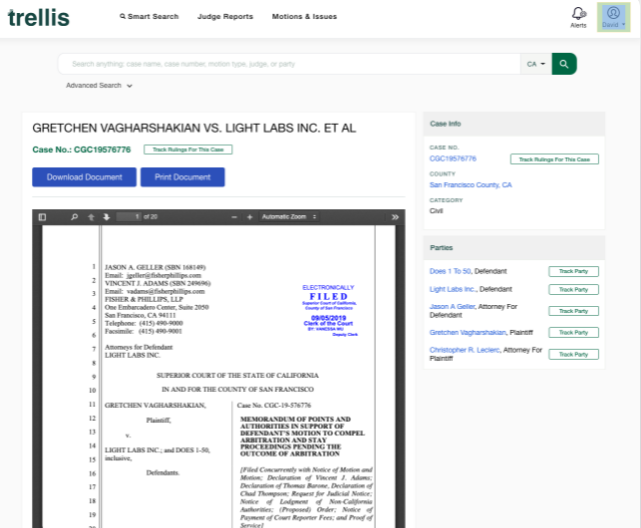
Source: sourceforge.net
| Access to filings and dockets across states | Description | Legal Application |
|---|---|---|
| Judge Analytics | Data on ruling patterns, grant rates for motions | Informing motion strategy based on past precedents |
| Docket Search | Access to filings, dockets across states | Supporting discovery and case timeline reconstruction |
| Opposing Counsel Insights | Strategy patterns, case histories | Enhancing negotiation and trial preparation |
| AI-Powered Tools | Automated argument breakdowns, drafting aids | Streamlining compliance with procedural rules |
| Alerts and Monitoring | Real-time updates on case changes | Aiding in timely filings and appeals |
Latest Developments or Case Status
A significant advancement came in November 2024 with the launch of Trellis AI, which builds on the platform’s database of over 2.5 billion records to automate litigation workflows. This includes tools for motion drafting, case evaluations, and client updates, powered by advanced language models.
Recent partnerships, such as with law firm Fisher Phillips, demonstrate practical adoption: Trellis AI generates Case Strategy Reports upon new filings involving clients, analyzing causes of action, defenses, and tactics. As of early 2026, the platform continues expanding coverage, adding more counties daily, in line with ongoing digitization efforts by state judiciaries.
Who Is Affected & Potential Impact
Trellis Law primarily impacts legal professionals—attorneys, paralegals, and law firms—engaged in state court litigation. For businesses, it means better risk assessment in disputes, potentially lowering legal costs through informed settlements. Consumers involved in lawsuits, such as personal injury plaintiffs, benefit indirectly via more efficient representation.
Potential outcomes include reduced research time, estimated at hours saved per case, leading to broader access to justice. However, for individuals whose public records appear, it highlights privacy challenges, though removals are limited as courts control sealing under rules like California’s Rule of Court 2.550.
Institutions like libraries and universities, such as Harvard Law School, use it for academic research, broadening its reach.
What This Means Going Forward
Trellis Law signifies a shift toward empirical litigation, where data informs strategy alongside traditional advocacy. This could influence industry standards, prompting more states to standardize digital access, as advocated by the Conference of State Court Administrators.
Readers should monitor AI regulations, such as those from the ABA’s Task Force on AI, to ensure ethical use. As litigation grows complex, tools like Trellis may become indispensable, but they underscore the need for human oversight to maintain fairness in the judicial process.
Conclusion
Trellis Law represents a forward-thinking approach to litigation, empowering legal teams with data to navigate state courts more effectively. Its integration of AI and comprehensive coverage highlights the evolving intersection of technology and law, ultimately serving public interest by promoting efficiency and informed advocacy. Staying abreast of such developments is crucial for anyone touched by the legal system.
Frequently Asked Questions
What is Trellis Law, and how does it work?
Trellis Law is an online platform that aggregates state trial court data for research and analytics. It works by allowing users to search dockets, analyze rulings, and use AI for insights, all via a subscription-based interface.
Can Trellis Law predict case outcomes?
While it provides data on patterns, such as motion success rates, it does not guarantee predictions. Outcomes depend on case-specific facts and judicial discretion, as per principles in cases like Daubert v. Merrell Dow Pharmaceuticals (on evidence standards).
How does Trellis AI assist in litigation?
Trellis AI automates tasks like drafting motions or analyzing arguments, drawing from court data to suggest strategies aligned with statutes and precedents.
Is Trellis Law available in all states?
It covers 46 states and over 3,300 courts, with ongoing expansions. Check the platform for specific jurisdiction availability.
What are real-world uses of Trellis Law?
Attorneys use it to review opposing counsel tactics in cases like hunting accident liabilities or holiday nuisance claims, reconstructing events through filings.
Does Trellis Law raise privacy concerns?
Yes, as it makes public records searchable; however, it complies with court access rules. Individuals can petition courts for sealing under applicable laws.
You may also like: Samuel Ford Stark: Biography, Work, and Lasting Influence